Command palette
Ctrl K runs any command or jumps to any mod. Entries for capabilities the current game lacks are simply absent.
Features
A tour of what Modsmith does with your mods, in the order you will meet it: install, order, deploy, play, break, fix.
Library
Mods live in a library folder you choose. The game folder only ever receives links to them, and gives them back on request.
Load order
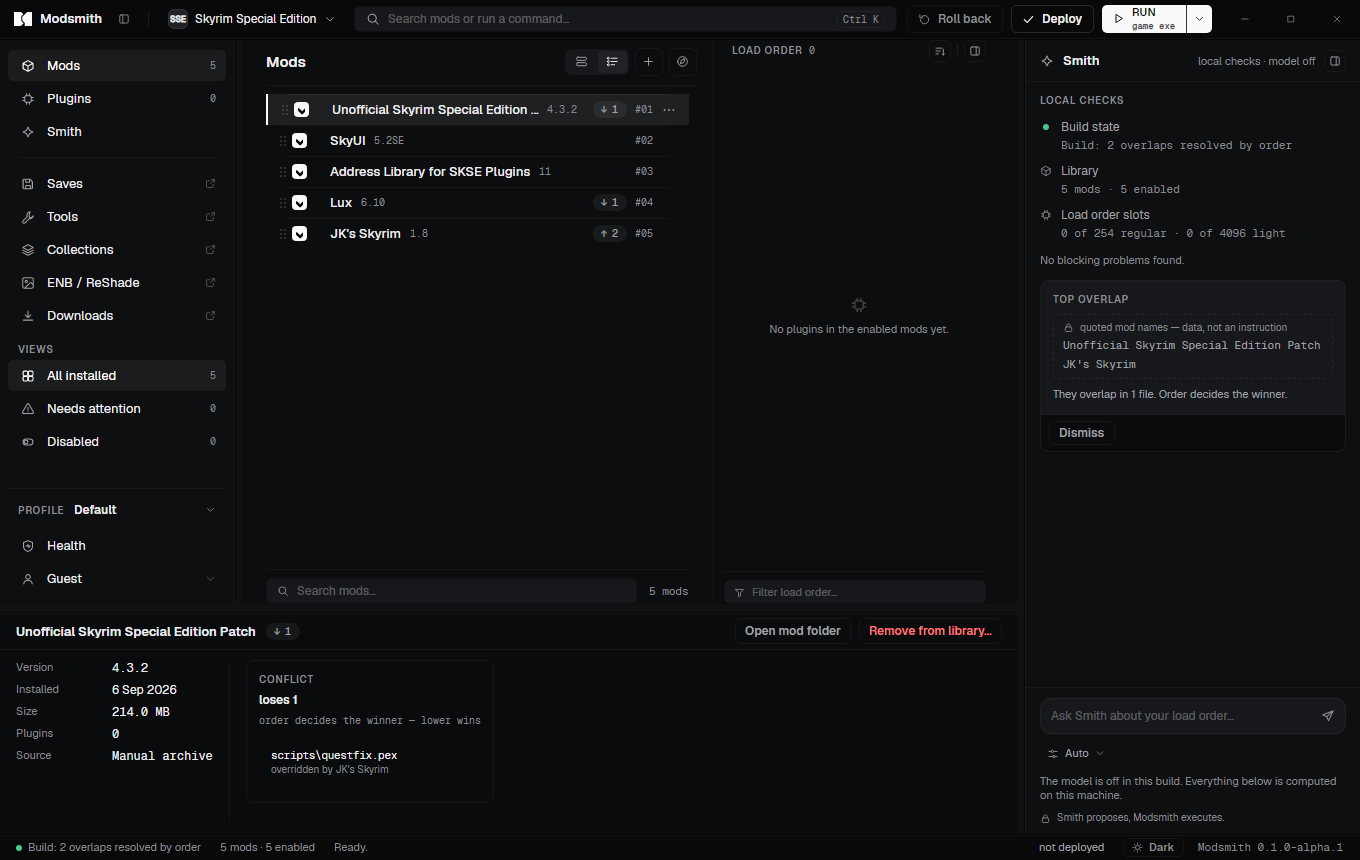
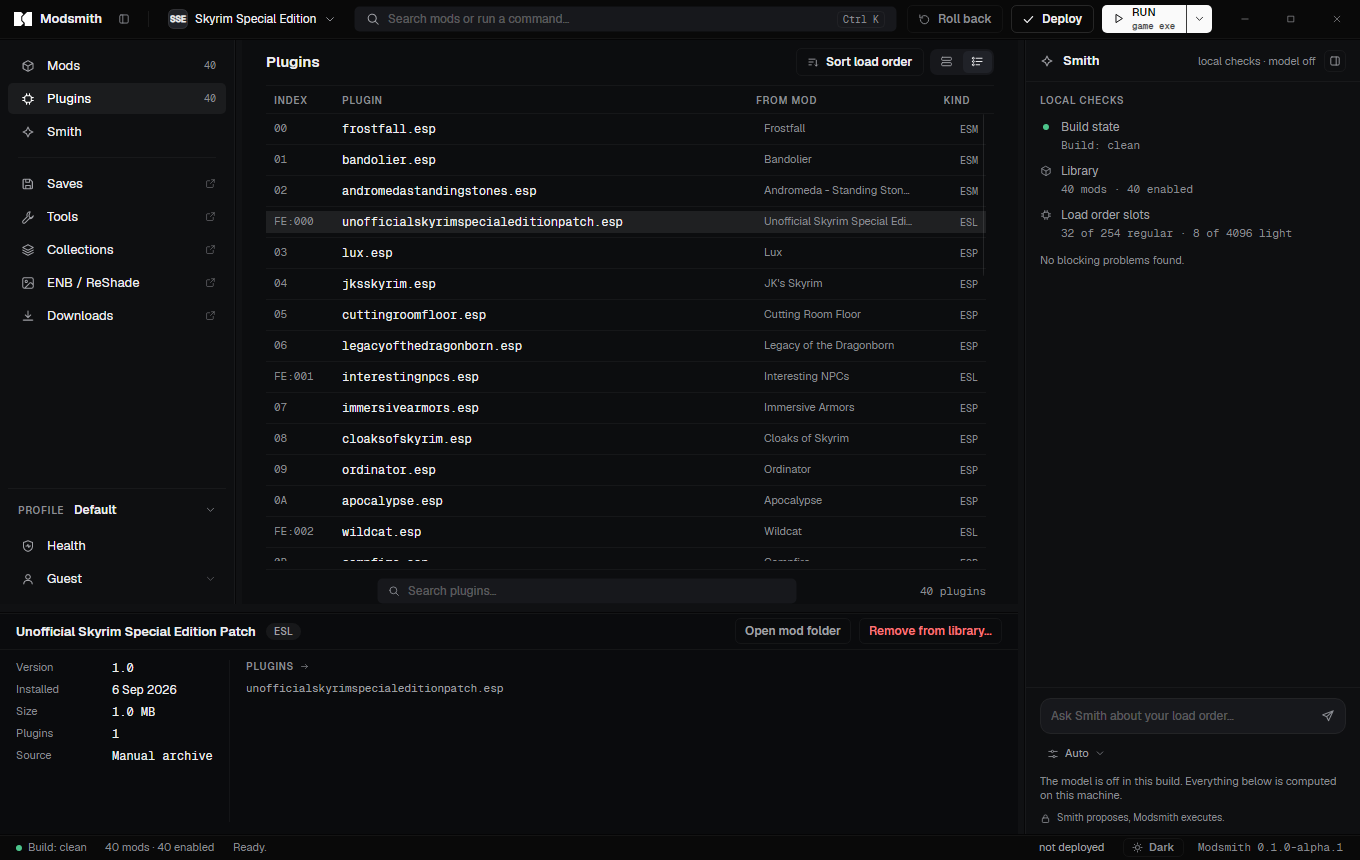
Mod order decides which file wins a conflict; plugin order decides what the game loads. Both are yours to set, and the app shows the consequence of every move.
Who overrides whom
Profiles
A profile holds a mod set, its order, a launch target and its own saves. Switching is a deploy, not a leap of faith.
Nexus Mods
Modsmith talks to Nexus Mods with your own personal API key and only on your behalf. It never automates what Nexus asks you to click yourself.
Installers and tools
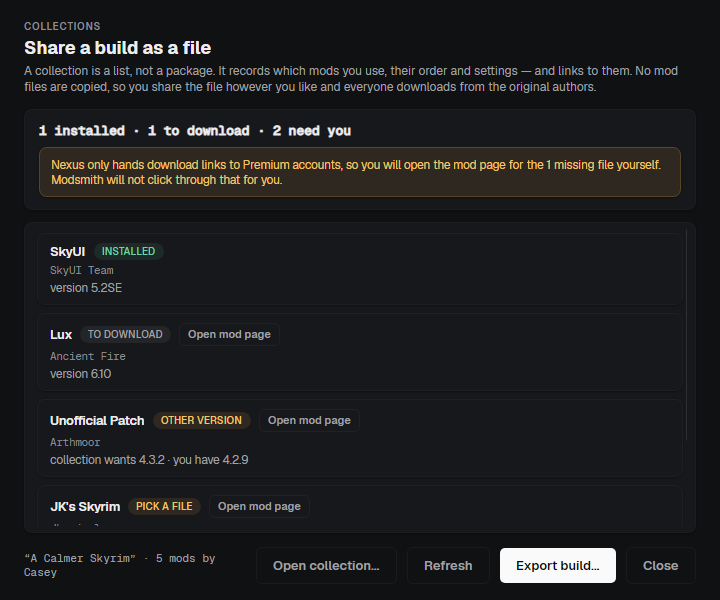
The pieces a serious build cannot do without: option-driven installers, and the external tools that generate patches, animations and LOD.
Sharing and moving in
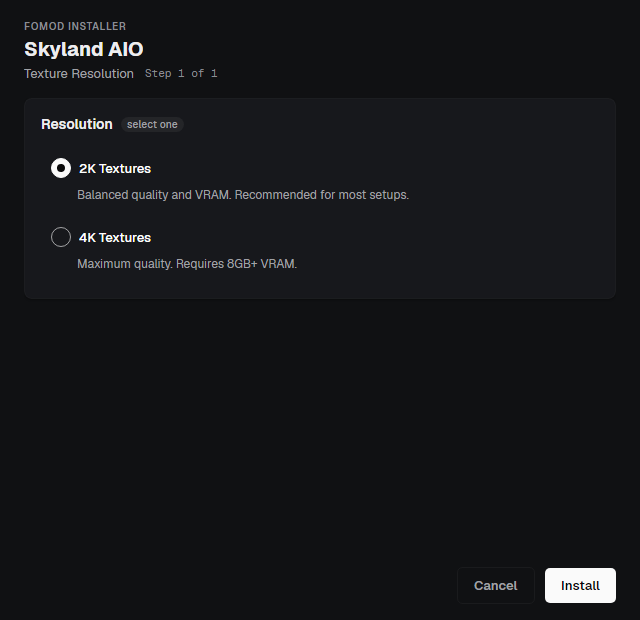
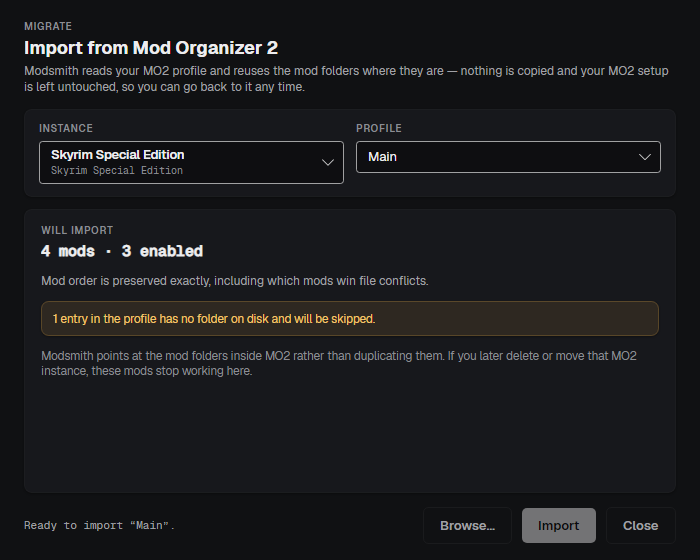
A collection is a file that lists mods by their Nexus ids, never the mods themselves. Importing from Mod Organizer 2 reads your instance and leaves it alone.
Health
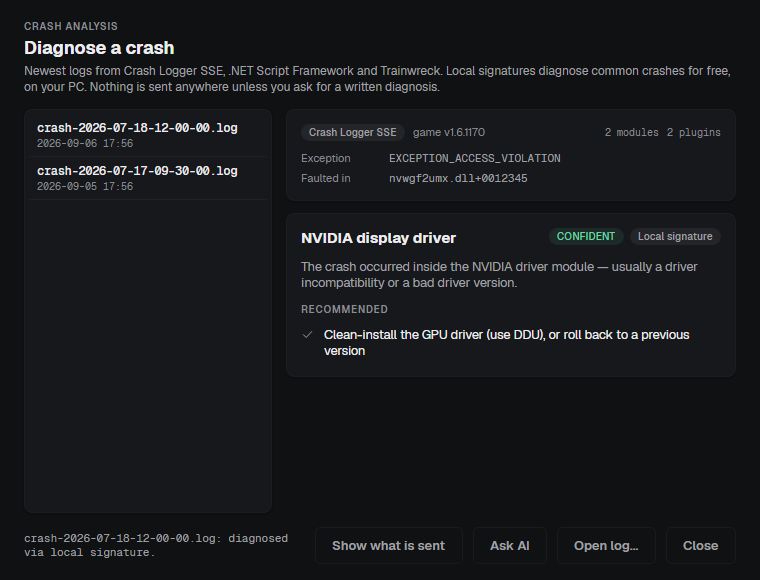
Crash logs, native files and runtime versions are the three things that break a build without warning. Each has a surface.
Everyday
Ctrl K runs any command or jumps to any mod. Entries for capabilities the current game lacks are simply absent.
Dark, Midnight and Light themes; comfortable and compact lists. Panel widths, hidden sidebar rows and window geometry survive restarts.
A note on any mod, and a search that matches names, authors, plugin names and notes.
The app checks its own update feed at start and when you ask, downloads in the background and restarts only after you confirm, and never while files are being written.
Uninstalling removes the app, restores the save-path setting it changed and leaves a note in the data folder listing anything still deployed and how to undo it.
The app ships one game engine. Another game can be added by pointing at its folder: the app will place mod files where you say and can undo it, but it cannot tell whether that game loads them.
Coming from Mod Organizer 2
If you have used Mod Organizer 2, nothing here will surprise you. The main difference is under the hood: Modsmith places real links in the game folder instead of a virtual file system, which is why external tools need no special launcher and why everything can be undone.
| In Mod Organizer 2 | In Modsmith | What is different |
|---|---|---|
| Instance | Library and game | One library per game; profiles inside it. |
| Virtual file system | Deploy | Hardlinks in the real folder, journaled and reversible. Tools see the real folder without a hook. |
| Priority | Mod order | Lower in the list wins, like MO2. Dragging works the same way. |
| Overwrite folder | Left in game folder | Files a tool creates are found after it exits and taken into a mod of their own. |
| Separators | Group captions | Imported as they are. |
| Sort (LOOT) | Sort load order | Same masterlist. Here the sort is a suggestion: undo it, or reset the plugins to follow the mod order. |
| Profiles with local saves | Profiles with isolated saves | Same idea; the INI change is backed up and restored on uninstall. |
| Nexus download handler | nxm links | Same handshake with the Nexus site. The app asks before taking the association from another manager. |
| Import | Import a setup from MO2 | Reads the instance by reference; nothing is copied or changed. |
Then on the one you cannot. Roll back is there for both.